Wednesday, August 8, 2018

Current Project: Fictionalizing West of the Revolution


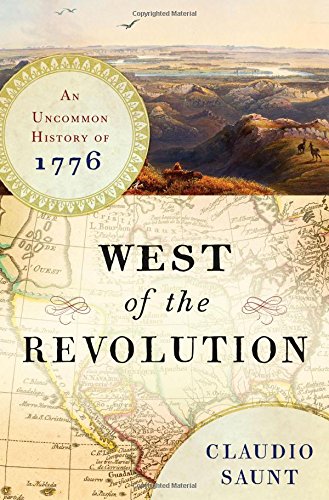
Book cover of Claudio Saunt, West of the Revolution.

For many, the most immediate contact one has with history is in fiction. I'm currently solidifying the syllabus for what will be my fall course, Fiction and the Historical Imagination: Fictionalizing US History, 1620-1920. The course will focus on some of the lingering mythologies of American history and the ways these are explored in fiction. I've mentioned before my intention to use Hamilton as material for this class, even as I've shifted the course theme a couple of times. Hamilton emphasizes the centrality of the American Revolution to myths of American history and identity while rearranging some of our ideas about what that big moment looked like and who the players were. But for every history that's been made into part of a founding myth, there are many that have rarely been considered at all, let alone given a fictional treatment. In this post, I'll explore the companion piece to the discussion of the American Revolution in my course: an assignment which will ask students to create contrasting historical fictions of 1776.

I didn't always realize this assignment would involve a creative element. As a teaching assistant at the Center for Talented Youth this summer, I watched my students take on a variety of creative projects related to the theme of the course, Politics and Film, all orchestrated by experienced instructor Jess Wilton. I was pleasantly surprised at what they were able to accomplish in a limited period of time, and on my return home I came to an epiphany--  In a course about the ways in which history is fictionalized, where we will gather to talk about the responsibilities and possibilities inherent in using fiction to make arguments about these larger-than-life mythological pasts, why would we not take a moment to create historical fictions of our own?

Our inquiry will use Claudio Saunt's text West of the Revolution: An Uncommon History of 1776. This great resource for expands the story of the American Revolution, providing an engaging, complicated view of the year 1776 in disparate parts of what would one day become the US. The book has many features of interest to discussions of history and memory-- I particularly enjoyed the brief reflections on historical memory at the beginning, in which the author notes that a giant cake he remembered as part of the national bicentennial celebration turned out to be, upon further research, actually related to a far more local event, the bicentennial of the city of San Francisco (12-13). I look forward to discussing with students this fall the ways our memories of history are so eager to fit themselves into the most dominant narrative touchstones.

One of the key appeals of this text for this project is the way that Saunt uses stories of an individual or group as a framing device for each chapter in order to personalize his geographically far-flung story. The book links Russian projects in Alaska, Spanish missions in California, and expeditions across the Great Basin as inciters of and responses to one another; pieces in a variety of efforts to control as much of the vast territory as possible. These broad themes are made manageable by each chapter's focus on an individual or group affected-- a group of seven Aleuts journeying on a Russian ship from Alaska to Yakutsk; Diego, a in indigenous man imprisoned at a Spanish mission in southern California-- who appear in the historical records but many details about whom we-- and he-- can only guess.

This emphasis on small stories of individuals makes it particularly well suited to students' dabbling in making their own historically-informed fictions. Immediately, we've got a few characters to play with when we begin thinking about how to transform this history into a different kind of narrative. Perhaps more importantly, Saunt proves himself willing to guess at possibilities and draw information out of seemingly minor players in Eurocentric records and make them central to the analytical and emotional crux of the argument. His transparency in doing so gives students a blueprint for how they and other writers of historical fiction can do the same.

Here's my lesson plan for this project, based around our fifty minute class period three times per week:

Day 0:
Divide class into 4 groups. Each reads the introduction to Saunt's book and one chapter from the first half of the book.
Day 1:
First 10 minutes of class: Group discussion on the introduction. What is Saunt's mission in this book?
Last 40 min: Groups get together and discuss their chapter with one another.
1st half: What happened in this chapter? Why is it important?
2nd half: Begin brainstorming an outline or draft of a fictional take on the history you've read.
Questions to consider:
What form should it take (Novel? Musical? Video game?)
What is the genre? (Comedy? Drama? Horror?)
Who are the characters?
What is the plot?
Homework: Create a draft or an outline of this fiction in consultation with your group. 
Day 2:
1st 10 min: Groups meet and tie up loose ends in the first version of their piece (draft/outline).
2nd 20 min: Split groups and create new groups with mix of people from each group.
Compare notes:
What is your fiction about?
What choices have you made about what to put in and what to exclude? How did you determine this?
3rd 20 min: Regroup. What did you learn, and how can you use it in your fiction?
Homework: Revise the draft/outline based on what you've learned. Distribute pieces to class.
Day 3: Share with one another.
1st 10 min: Quick 2 minute introductions to works from each group.
2nd 20 min: Exploring the drafts. Students will read, play, or otherwise examine what other groups have created.
3rd 20 min: Sharing analysis of the works as a class.
Discussion questions:
What did you learn?
What is the historical narrative?
What is emphasized and what is downplayed from the chapter?

Some of the challenges I anticipate with this plan relate to the relatively limited amount of knowledge students will have about the chapters outside of the one they have read, potentially making it difficult for them to evaluate other groups' fictions. However, I also think that this serves as an opportunity to motivate students to consider the fact that this is frequently the case in historical fictions-- rarely are historians the intended audience for a historical film. When developing their fictions, then, each group should be thinking about the fact that they will be introducing a topic to an audience that doesn't have the benefit of the exact knowledge they possess about it. I look forward to trying out  this lesson plan in less than two months!

Do you have any favorite resources on 1776 or historical fiction? 

Related Links:
An episode of the podcast Ben Franklin's World, in which Saunt discusses the events depicted in his book. 
A Chicago Tribune review of West of the Revolution.

Wednesday, July 18, 2018

Reacting to Reacting: The Embodiment of Bourne


Randolph Bourne at typewriter.
I brought two books on my trip to Princeton to work as a teaching assistant for the Center for Talented Youth. One of these was the script for Body of Bourne, a play that deals with the life of Randolph Bourne, an antiwar thinker and bohemian. One morning I found myself sitting at breakfast in a dining hall on Princeton's campus, reading the scene in which Bourne has been accepted to Princeton but is unable to go, lacking the financial support his uncle offered only to Bourne's abled sister. Bourne never made it to Princeton; instead, he worked six years in an low-paying job and eventually raised enough money to attend Columbia University.

As you might remember, Bourne is one of the bohemian roles in the Greenwich Village, 1913 Reacting to the Past game. His role in the game is to promote bohemian ideals, particularly those of multiculturalism and the influence of youth on social change. But how did he come to care about these things? I've previously written about his college days at Columbia and the commitment to women's rights and labor issues espoused by his editorial in the Spectator. In this post, I want to explore another of his pieces, one critical to understanding the formation of his ideals and the experience of embodiment in the early 20th century US: "The Handicapped-- By One of Them."

Initially much of the scholarly work on Bourne suffered from a misleading mind/body dualism. Bourne has long been regarded for his mind, and his ideas continue to hold weight among liberal and radical thinkers-- he was even the subject of an article on current politics in the New Yorker in August 2017. His antiwar stance and embrace of multiculturalism as a boon to American life have made his ideas feel fresh to multiple generations. His body, however, has often been portrayed as either a mere footnote to conversations about his intellect or a tragic obstacle he overcame-- in other words, he is a notable thinker in spite of disability. The back cover of Bruce Clayton's Forgotten Prophet: The Life of Randolph Bourne, for example, suggests surprise that the "disfigured and hunchbacked" Bourne "reacted to his disability not with bitterness or self-pity, but rather with exuberant love for beauty and a compassion for humanity"-- in other words, it is a pleasant surprise that Bourne was able to resist bitterness and develop a compassionate view of the world. 

This viewpoint on Bourne is all too common; the great disability scholar Paul Longmore criticized these trends in scholars' work on Bourne in his review of Forgotten Prophet by saying "The problem with it, as with all Bourne biographies, is its fundamental misunderstanding of his experience and identity as a disabled man in a society that intensively stigmatized him." Longmore was so interested in this side of Bourne that he took up the topic twenty years later in an article with Paul Steven Miller, arguing that Bourne's experience of disability (or "philosophy of handicap," a phrase Bourne used to title "The Handicapped" when it was reprinted) was the foundation of his radicalism. (In many ways, Body of Bourne and the Longmore/Miller article are companion pieces, making harmonizing arguments through contrasting means about the role of body in Bourne's political thought.)

Bourne saw handicap as a critical part of his experience and his ideology. The category of handicap, as Longmore and Miller explain, is less about bodily function or impairment and more about social expectation. Bourne's "The Handicapped" opens by claiming that in many ways, it is easier to be "helpless" and happy with any little diversion you can get than it is to "move about freely," but with a "crooked back and unsightly face" and have to strive and work for opportunities frequently denied you. Employment, friendship, and day-to-day tasks are all hampered, as he goes on to describe, not by physical impairments but by the low expectations of others. Most successes must not only be clawed for through perseverance (akin to the can-do attitude promoted by rehabilitationists of the era) but also at some point permitted through the explicit cooperation of an abled person.

As this need for cooperation might suggest, the difficulties Bourne related were socially informed-- they did not hinge on the body's function but on others' perception and treatment of that body. Bourne could have stopped his essay and his ideology there-- i.e, "my experience has taught me that peoples' perceptions of my body affect me negatively"-- but instead, he explained that this had contributed to a broader understanding of the ways in which people's status and success were influenced by social factors outside their control.
It makes me wince to hear a man spoken of as a failure, or to have it said of one that he "doesn't amount to much." Instantly I want to know why he has not succeeded, and what have been the forces that have been working against him.
Bourne extended the idea that people had underestimated him to a consideration of the roles of others within his society-- i.e., "if I am being underestimated and blocked from success, others must be suffering the same treatment." He prized this aspect of himself, noting that the knowledge was worth anything he'd endured to gain it: "If it is solely to my physical misfortunes that I owe its existence, the price has not been a heavy one to pay." 

At first, "The Handicapped" was printed anonymously (hence "By One of Them"), which Ned Stuckey French posits may have been due to embarrassment of his disability; I suspect concerns about having his other published thoughts disregarded, and thus his livelihood and reputation affected, was the key motivator. The worry of being flippantly disregarded is key to this piece; he even cites it as one of the worst things he experiences socially: "What one does get sensitive to is rather the inevitable way that people, acquaintances and strangers alike, have of discounting in advance what one does or says." Publishing this piece represented risk for Bourne, who likely did not wish to jeopardize the success of his other political writing.

Reactions to Bourne's "The Handicapped-- By One of Them" suggest that themes Bourne raised resonated with disabled readers of the Atlantic Monthly. Some readers wrote to thank him for his words. Bourne's correspondence, held by his alma mater, Columbia University, include two letters from different women who signed their communications "Another of Them," in reference to the title of his piece. Both thank Bourne for his writing, saying that it had encouraged them. They offer brief details of their own about their lives in support of his points: one notes that she is writing both for herself, an "old woman who is learning to bless her handicaps for the insight they are bringing into the possibilities of life," and for her brother, still struggling in the "darkness, the weight of his handicaps heavy upon him." His greatest problem? The "lack of intimate friends," which Bourne highlighted in his piece; which several sources suggest was critical to both the greatest joys and sorrows of his life; and which frequently, especially at a time when socializing was much more circumscribed by place and social circles, necessitated the need of cooperation by abled friends and family.


Related Links:
An early review of Body of Bourne in Variety. It's a great intro to the man and his life, so read or see it if you can: I got the script through Interlibrary Loan, and there's an upcoming production at Oberlin College next year. You can also see an interesting image of the original performance at Getty Images.
Bourne's "The Handicapped" appears in a variety of places across the internet, including the Disability History Museum, the disability rights publication Ragged Edge Online, and The Anarchist Library. The second form of the piece can be found in Youth and Life.
Randolph Bourne at the Disability Social History Project
More of Bourne's writing available at fairuse.org
Weird connections: the New Yorker article mentioned above was written by Jeremy McCarter, author of two books: Young Radicals, about many of the Greenwich Village bohemians including Bourne, Jack Reed, and Max Eastman; and Hamilton: The Revolution.

Archival Citations:
Another of Them to Randolph Bourne, September 1911; Randolph Bourne Papers; Box 1; Rare Book and Manuscript Library, Columbia University Library. 
Another of Them to Randolph Bourne, September 14, 1911; Randolph Bourne Papers; Box 1; Rare Book and Manuscript Library, Columbia University Library. 

Monday, June 18, 2018

Current Project: Making a Course You Love

I've talked before about being a proponent of giving students an excuse to spend time on something that interests them, having relished those opportunities during my own education. There are so many obligations which face students that they must prioritize, and wrapping some freedom of choice into assignments allows them to reflect on what sorts of things they might be intellectually passionate about. Today I want to talk about the flip side of this concept-- instructors and the freedom they have to steer the content of a course toward things that pique their interest.

An empty page for only me to fill! Should I hold the light bulb over my head, or...

I've been prepping on and off for the last few months for my fall course, Fiction and the Historical Imagination. It's a fun one to organize not only because I'm always interested in how history is portrayed in fiction-- for this iteration of the course, I'm examining popular mythologies and narratives about American history in a variety of fictional sources from theatre to video games-- but because it's enabled me to expand on some topics and questions I've already taught in a much more limited sphere. Only semi-intentionally, this course positions itself roughly within the same time periods as my Reacting to the Past course. It begins with Massachusetts Puritans-- albeit to talk about the Salem witch trials in 1692-1693 rather than the Anne Hutchinson trial in the 1630s. And it ends in 1920 with the passage of the 19th Amendment, arguably the paramount goal of the Suffrage faction in Greenwich Village, 1913. So in many ways, it's as if I'm coming at much of this material backwards in planning this course. First, I helped two groups of students live the history; now I and a new group will together delve into the background, the historiography, and the popular memory which surrounds and bridges these two events. 


It’s a great opportunity to incorporate the knowledge I have gained from the games into a (slightly) more conventional seminar-style course. Not only do the names and dates associated with these periods come more naturally to me than ever before, but also an appreciation of the humanity, subjectivity, and tendentiousness of historical moments that Reacting emphasizes. I feel I have a grasp on some critical theological ideas of Puritan life that I might not have appreciated without having led students to those realization in the Anne Hutchinson game. One of my former students commented that she had come into the course thinking the Puritans were nonsensical people, but that the game had given her an understanding of their priorities. It's also helping to me envision a future course that marries both approaches; for example, a deep dive into the Puritans which incorporates both the Salem material and the Anne Hutchinson trial. 


The difficult part, as always, is transmitting knowledge and appreciation in an effective way to a new group. I know I will want to refer to the events of the games (much as I always make popular culture references in class that only two people understand), and being that there are only a couple of repeat customers I will have to restrain myself! 


Tailoring a course to something you'd like to talk about in this way offers a lot of fun options, but it also threatens some pitfalls. Many of us, I'm sure, have taken or heard of courses that were clearly serving only the instructors' interests and not those of the proposed themes. How do we lean into the freedom to shape a course we're excited about without ignoring the needs of the course as a whole? 

I don't claim to have all the answers-- hey, this is my first time doing something quite like this!-- but here's the general rules I've tried to make for myself in this process:
  • Lean into joy rather than expertise-- that is, try for a course that emphasizes the things you think are really interesting rather than the very specific thing you are personally studying. These can of course overlap, but enthusiasm draws in people who might not care about the topic, whereas no amount of encyclopedic knowledge on children's hospitals during the Depression era can convince folks to stay in your course past the drop date.
  • Related: Try not to be completely self-serving-- if something helps you with your reading to-do list, your prep for a conference, or just saves you time because you already have a lecture for that, consider whether it also serves the course well. There are many things I've considered incorporating that I've just had to cut because they weren't quite pulling their weight for my overall goals (but, okay, I'm still working on it). 
  • Don’t hesitate to embrace the new/fun-sounding-- if you have the time, try to break out of what you've done before and use new resources-- you might find things you never knew existed. For this course, I decided to use Valiant Hearts: The Great War as a fictional source to discuss US involvement in World War I. This decision led me to learn of the Gaming Initiative and try out the Gaming Center at the Undergraduate Library, as well as learning the game had iPhone and Android versions. Now that I know that those things exist, how they work, and who to talk to about them, I can not only use them with greater ease in the future but also refer students to those resources and describe how to use them. 
  • Related: Don’t embrace the new/fun just because it's new/fun-sounding-- this is particularly true for online materials, which bill themselves as being the newest most fun millennial/Gen Z appealing way to learn but in reality are often poorly structured and frustrating to both the computer unsavvy and the technology buff. If you don't have time to test the new thing and see if it's actually helpful, the old books/primary sources/paper copies/presentation styles are just fine. 
You'll notice a pattern here-- there's a middle ground that I'm aiming for, a happy marriage of all the considerations of structure, effort, enthusiasm, knowledge. A balance between knowing and discovering which brings vibrancy to a group discussion of ideas-- which is, after all, what a seminar is at its base. 

Do you have any tips for using intellectual interests to power a course?

Monday, May 28, 2018

What's History: Inappropriate Beach Reads and Finding New Perspectives

A woman reading near a pool. 


This New Yorker article has thoughtfully laid out the qualifications for a good summer read, but I must admit that I have frequently broken these reading rules at the beach and/or pool. I'll go for some classic beach fare, sure-- an issue of Cosmopolitan, a book with a beach on the cover or centered around a "crustacean-centric eating party." However, I have historically (haha) also heavied it up with some hefty reading for research, teaching, or--horrors-- exams. I once memorably spent a day at the beach in Santa Monica reading A Short History of Reconstruction.

This is not because I am so darn studious but rather because the pleasant setting makes work more palatable. If I'm going to read, why not do it outside? The change of scenery works wonders for my mood and often my concentration, and the weird timelessness of lounging beside pool or ocean often stirs my brain to come at ideas in a more patient fashion than it might otherwise. Don't worry, there's always a backup magazine nearby in case of emergency.

So recently I took this approach to new heights. I printed out pages of the Michigan Hospital School Journal that I've been using for dissertation research and read them in the pool while on one of those floaty things (yes, they got a little damp). I was pleased with the success of my method-- I took a few notes on the pages and got through the day's reading rather quickly.

The next day I came across an interesting letter in an issue of this Journal. The Journal was published by a convalescent home in Farmington during the 1910s-1930s which reported on the goings-on of the institution, but it also had wider appeal as a passionate call for the education and rehabilitation of children with physical disabilities. Among other material, the editor frequently included letters from all sorts of readers-- state officials, children at the hospital-school, members of other progressive organizations, and disabled adults expressing support and encouragement for the Journal and its mission. 

The letter that so caught my attention was from Percy Angove, State Supervisor of Industrial Rehabilitation, published in the Nov-Dec 1922 issue. He began his note by saying:

I am on my vacation and my greatest enjoyment at the present time is looking through and reading articles in my treasured bound volume of The Hospital School Journal. This is the greatest compilation of its kind or anything similar that I know of…

"My greatest enjoyment at the present time"-- strong words! What a glowing review of a periodical called The Hospital School Journal, and which frequently featured items I find dry, hard to plow through, or repetitive. Surely the Journal has brought me joy as well-- some of the calls to action that editor Joe F. Sullivan delivers are still stirring almost a century on-- but sheesh! I had a sudden image of Angove sitting on a porch overlooking a Great Lake, sipping iced tea and thumbing through his hardbound volume with delight.

I realized this was not such a dissimilar image from what I had been doing the previous day. The combination of the letter and the laid-back setting helped me see the Journal from a perspective other than the straightforwardly critical lens that serves as default. I tried to put myself in the shoes of this Progressive-minded man on vacation, enjoying his recreational reading, taking a week away from supervising industrial rehabilitation to sit and read a magazine which is, at it's heart, about children's orthopedic treatment.

When I came back to the Journal, I thought about what might make the magazine so joyful in Angove's mind. Certainly a shared pro-rehabilitation leaning between reader and material was at play, but with my new frame of reference I could also appreciate how light the material could be-- notes on picnics and parties, photos of happy children, short poems and tidbits, and reader letters on a variety of subjects, which are interesting in the way that reading someone else's correspondence can be. The language of most of the articles is pleasantly straightforward. And of course, as the publication hoped to drum up support for what they called "crippled children's work" as well as reconstructive surgery and training more generally, the Journal printed plenty of stories of satisfied customers-- happy children who had grown into employed, articulate adults. This was probably also part of Angove's enthusiasm, akin to the human interest stories and videos which still capture public attention and make us feel hopeful about people.

As teachers of history, we focus a lot of attention on teaching students how to read "like historians"-- from a scholarly, analytical mindset. However, reading like historians also involves reading like historical actors, pulling out not just what we can see in a text but also what might have stood out to the people who read it when it was first produced. Perhaps our teaching could incorporate this more explicitly-- not just asking "what would X group say about this document?" after all have read it but also encouraging students to read documents with a particular mindset. I aim to explore, in future, how to incorporate multiple methods of reading sources into classwork, looking not only for what the text itself is saying but what might have provoked interest, pain, or--yes-- greatest enjoyment of its early readers. 


Related Links:

Monday, May 21, 2018

Enough About Me: Embracing Options

A row of white doors. They'll all get you where you're going!
Whenever I am struggling to gather my thoughts about a project, I like to attend a workshop or a lecture. Though one often goes to a talk to hear about the presenter's thoughts on the subject presented and learn something new (a good reason to go, as a rule), I find that they are also useful for reminding me of things I've forgotten or have neglected, and for giving me the space to think over a problem. By taking in new arguments and information, I have the chance to look at new things in a new way, and am often inspired to look at an old thing I've been turning over in my mind in this new way as well. 

Sometimes I gain a new understanding of what I want to say; sometimes I realize something I've already been expressing, but which has remained opaque to me. One of the most amusing events in my academic life was attending a wonderful talk on campus by Natalie Lira and not only learning quite a bit of historical information but also coming to some realization about my project (I've now long forgotten exactly what it was). When I told my advisor enthusiastically, she said, "Yes, I knew that's what you were doing." It was apparently clear in my writing, but it wasn't clear in my head until I'd had the chance to reflect on it from a different angle. 


An Example: A UIUC Writers Workshop Workshop

So, after a difficult spring, I found myself in an hourlong presentation held by the UIUC Writers Workshop: "Staying on Track With Thesis and Dissertation Writing," facilitated by Logan Middleton and Adrienne Pickett. You can probably imagine what this sort of thing consists of-- a discussion of the various stages of writing (from research and organization to prewriting and drafting to revision and writing groups), some recommendations about writing consistently, some sharing stories around the room about how we organize our notes, how we sit down to write, how we deal with feedback. It had all of the ingredients that you might expect, and little information that was brand new to me.

If I wasn't confronted by wildly revelatory information, why did I find the writing workshop so helpful? Some brief factors:

  • It's sometimes necessary to be reminded of things you kind of know already because as humans our memories are short. Anyone who's discussed anxiety with a professional knows that they should do their breathing techniques in times of struggle; anyone who's tried to manage anxiety over an extended period knows the feeling of sheepishness they get when reminded that breathing is an option available to them which they have rudely cast aside.
  • Several organizational choices made by the facilitators were also a key factor: beginning the workshop with time to reflect on our own struggles with or approaches to writing; the opportunity for attendees to engage in conversation about each topic as the program proceeded. These tactics created a casual but engaged atmosphere.
  • It's also nice to devote some time just thinking about the process of a large task you need to do, to have some outside confirmation that the strategies you are using are considered worthwhile by others.
But these are all preludes to the main topic I want to discuss here. More than any of these other aspects, I was heartened by the ways in which Pickett and Middleton offered options about writing, rather than prescriptions for writing. 

What do I mean by this? Let's take the portion on drafting the dissertation as an example. The facilitators suggested that one should consider scheduling a time to write, and that one should try to schedule more frequent short periods to write rather than fewer long stretches of time. They gave specific examples of this concept: try two hours of writing time four days per week, rather than eight hours on Saturday-- same number of hours, but more spread out. Additionally, they advised setting "small achievable goals"-- for example, 300 words per day; or an hour revising the introduction.

Set goals based on time or words; be consistent-- this is advice that is common, yes, but is also commonly given like this:

  • "Oh, you have to write first thing every day if you want to get anything done."
  • "You need to write 500 words per day. Every day. Even if you are going to Disneyland."
In other words, many offer prescriptions for what exactly you must do to achieve your larger goal. They take the specific application of a general principle and make it the sole factor in success. Without doing this one weird trick, you'll never make it! (Weirdly, the one weird trick is different for basically everyone in its specifics, and yet everyone persists in believing that theirs will work for everyone else.) This kind of thing always stresses me out more than it motivates me to try it because I can already envision the many ways in which I could fail to carry out the maxim. Middleton and Pickett, conversely, offered parameters for what those goals can look like, which gave us the tools and the freedom to determine our own goals.

I don't mean to suggest that this workshop is the only place to get an option-based approach to writing, or that one can't find success with a prescriptive approach. But it did inspire me to reflect on what I found compelling about the style that the facilitators used and reflect on how I could incorporate this into my own teaching. 

What's the Point? 

It should be no surprise to any consistent reader of this blog by now that in many ways, I teach by learning; that is, my first step is to consider how I have learned and try to mimic that process. Fortunately or unfortunately, variety is a big part of how I learn-- switching settings while writing or studying, typing some notes and handwriting others, coming up with new ways to read or annotate when I have tired of the old ones midway through a semester. 

I tend toward emphasizing variety in my teaching as well. I like to switch between different types of sources to see how something looks different as told through different media or by different types of people. I don’t like to do small group work often because it tends to fall into the same types of patterns, preferring instead the random observations that tend to come out of large class discussions or paired conversations. 


So obviously I liked this idea of emphasizing options rather than prescriptions about completing assignments-- it certainly offers variety! It's hard to provide writing support in our classes because writing is such a solitary activity, and there's something endlessly mystical about it. How does something get written? How does a good something get written? The answer, of course, is that there are as many ways that this happens as there are people who write good somethings. 

When teaching first- or second-year level courses, we are also confronted with the idea that part of our goal is to teach good processes for writing and other forms of analytical work so that students can maintain them for the duration of their lives. How can we encourage the divergent work processes of people who haven't necessarily developed an effective work process yet? Faced with the enormity of this, we tend to double down in our teaching on the things that we can know or declare: we want thesis statements, we want topic sentences, we want evidence and analysis. The only thing we say about the process is, "Don’t start it the night before! We can tell!" 


Incorporating Options

So, how do we lean toward options rather than prescriptions in our classes, while still maintaining clarity about expectations and assignments? 

Outside of Class

I've talked about this a bit before in terms of assigning unstructured research time-- offering students an "excuse" to spend some time thinking over a topic without the pressure of creating some artifact for grading. In a course with a big final paper or a consistent smaller written assignments, this could be broadened into an assignment which encourages students to reflect on what kind of goals might work well for the writing assignments they intend to complete and the time they have to work with. If there is a paper due every other Friday, a student might make a goal to spend fifteen minutes jotting down the main points of every reading after completing it so that she can remember them. Another student might focus on the actual drafting of each paper, committing to have a page written by the Wednesday before the due date each week. And another student might wish to focus on actually having time to edit the paper, and resolve to commit an hour on Friday mornings for a final readthrough. 

This process should also incorporate a continual renegotiation of those goals based on changing circumstances. For example, the student who wished to focus on editing may realize a month into the semester that his work schedule or his other courses never allow an hour for editing on Friday, and so he may wish to alter his goal to be more achievable.

Inside of Class

As far as in-class activities go, lots of teachers do this by spending time on prewriting strategies. Prewriting is perhaps the most wiggly step of the writing process and there are a lot of good resources out there about the many ways that one can prewrite-- brainstorming, freewriting, journaling-- a lot of these are really just fancy words for "starting to write and seeing what happens," which in my experience isn't so far removed from "drafting an undergraduate paper." There are also approaches that diverge from these, like clustering, which is a bit more graphical; and outlining or journalists' questions (what we used to call the 6 w's-- one comes at the end, see?). I like presenting these as options for beginning an independent writing project, and I also like the idea of fostering the opportunity for students to dabble in several of these in class and discuss how each worked for them. Perhaps it doesn't come naturally for someone to cluster (it certainly doesn't to me), but it’s a wonderful thing to try in class when you're not actually scrambling to get the paper done right at that moment.

However, I must admit that I remember finding these sorts of activities only minimally helpful when I've been in classes where they've happened, and I think much of the difficulty there is timing. You've gotta talk about prewriting early, while people have time to benefit from it before they really should be writing the paper, but it's also hard to do prewriting before you've done any research, which I had rarely done at that point. So, I think a spirit of experimentalism is best-- ask students to use prewriting activities to brainstorm a hypothetical paper based on something you've all already discussed together in the course, and talk about the results. 


How do you balance options and prescriptions for writing, as a teacher or a student?


Monday, April 30, 2018

Current Project: Cutting it Down to Size

Scissors.

I've spent a lot of time in the past year--heck, the past three months!-- applying for various things, like fellowships and summer positions. Now that I have a proposal that decently explains what my dissertation project is, it's not so hard as it once was to apply for these kinds of things because I don't have to start from scratch. However, it is a great exercise in editing, for in addition to the specific pieces I have to write for different things (What collections will you use at this library? What's your teaching background?), I need to cut or lengthen the basic description of what it is I do, exactly. This process has led me to think about whether it might be fruitful to incorporate the skill of cutting work down to smaller sizes into a classroom activity, and how it could be done. 


Short Descriptions

 It's hard to write a short description! That's why there are eleventy million resources on how to write an abstract. It's particularly hard to be brief if you're trying to convince the reader you're exceptionally smart and have many complex ideas. As a recent panel on historians writing historical fiction observed, "graduate school ingrains students to write in technical, polysyllabic language." How do you express the complex ideas you've explained in a 13 page proposal when you have a 300 word abstract to work with? How do you decide which jargon to center and explain and which to eschew in favor of simplifying the story? And its particularly exciting to do so when you already have a 500 word description which you feel is perfect-- and need to cut it to 300 words.

This is an academic problem, but it's also an everyday life problem. There are good and probably boring real world examples about business or whatever, of course (Cover letters! Product descriptions! Interview prep!) , but here's a good silly one: haven't you ever wished, when you were stuck in the corner at a party being bored to death by a thousand-word story about a ten-second interaction, that someone had taught that person how to edit?  


Editing and Peer Review

Editing is no fun, obviously; this is why I generally resort to printing things out in hard copy to go over so that there's a physical pile of papers shaming me into doing it ("You paid $2.20 to print me at the library just so you can sit there scrolling Twitter and listening to Gilmore Guys?" it hisses). Undergraduates also know that editing is hard and also no fun, which is why peer review is such a common and such a hated process in college classrooms. It's a good way to get everyone to try their hand at editing, but it's also a guaranteed groan-eliciter. The only thing I want to do less than edit someone else's paper is have them help me edit mine, which makes me feel both overwhelmed and tired! 

Peer review is cool and important and I do it all the time with other graduate students but I have to admit that I almost never incorporate it into my lesson plans because I remember getting nothing out of it when I was in college. The thing about peer review is that if you don't totally trust your peers expertise, you can easily dismiss very valid criticisms that you don't want to deal with by saying that they don't know what they're talking about. I know! I've done it! So, if people in my courses want to help each other edit, I encourage it but rarely arrange it. (Reacting classes, which make a bunch of people work together in factions to achieve goals, are good for encouraging this voluntary editing of one another.)  

Editing something to be not just better, but also shorter, is its own particular challenge. It is a bit better for peer interaction: you can quibble with "you should say 'barn' instead of 'rural horse hostel' because it sounds better," but it's hard to argue with "'barn' takes up only one word and 'rural horse hostel' takes up three and you're still twenty-three words over the limit, so kill your darlings, already."

So, with all this roiling around in my brain as I was falling asleep the other night, this activity idea popped into my head. It's called "Sudden Death Edit," and it's a little like the game of Telephone.


Sudden Death Edit

How this works:

  1. Everyone contributes an assignment of moderate length. A typical five page paper is ideal. Students are asked to read the first paper they will edit in advance.  
  2. At the beginning of class, each person has fifteen minutes to cut that paper down into a one page statement. 
  3. At the end of fifteen minutes, original and one page papers are assigned to a new person. That person cuts the work down to 300 words. 
  4. After fifteen minutes, the paper and all revisions are passed to a new person. That person must condense the statement to 200 words.  
  5. Last round: new editor, fifteen minutes, 100 words. 
  6. Postmortem: reflect on the progression of the pieces and ask people to share about their experience of editing others' pieces and of seeing the edits of their own writing.

Discussion Questions:

  • Did the edits lose or gain coherence? 
  • What choices were made in the summaries? Were there any you especially agreed/disagreed with?
  • When you worked in your summaries, did you use the full piece more or the latest summary more? 
  • Which round was the hardest?

Bonus Rounds:

  • Sometimes you have to grow a statement rather than shrink it. Give everyone a paper and its 100 word description and ask them to make a 300 word description.
  • How does the whole thing change if it's going to be spoken aloud instead of read? Have students transform short descriptions into brief presentations if you're formal, or descriptions to a friend if you like keeping it casual. 

Notes:

  • If you have everything in an online space and get everyone to bring laptops to access it, this could be the easiest way to deal with counting words and accessing each other's writing-- each paper could be a separate post in a forum on Compass or Moodle or Blackboard, and then each round of revision could be a separate comment in that thread by the editor. This method also makes the trajectory of changes easily observable by all. 
  • The base activity here is designed for an hour-fifteen class period, which I have never actually had the pleasure of teaching! To shorten this, you could eliminate a step, use shorter pieces to begin with and thus lose the first step, or really hot-seat it and make each round ten minutes. 
  • If you want the original writers to have more involvement throughout, you could make this a pairs activity and have pairs hand their pieces back and forth. I love pairs! Pairs are the new groups, in my mind. More on that another day, I'm sure.
  • This activity is obviously good for its stated purpose, learning to write short descriptions. But it's also a nice exercise for figuring out what exactly a piece is about, what the important elements are, and how to explain them in a briefer period.

Related Links:


Monday, April 16, 2018

Take My Advice: Starting On Secondary Lit

 
Stacked books. Photo by Anthony from Pexels.

One thing that I still find intimidating is the vast amount of secondary literature in the world. How do you make sense of what historians have said about a field that is new to you? Getting a grip on historiography is something that hasn't come naturally to me, but it has been a continual process of discovery and false starts in my career as a student and teacher of history. In this post, I want to talk a little bit about one way in which I've approached getting to know the state of a field-- an activity I call the Fifteen-Minute Filter.

Why Bother?

The need to get a quick idea of a field is applicable to a variety of levels of study. You may be an instructor designing a new course or a graduate student studying for exams or a researcher writing an article, in which case you've likely had some experience with the concept of historiography. However, I first encountered this need while taking upper-level undergraduate classes. It can be a tough transition between papers for lower- and upper-level history courses. In the lower levels, the readings tend to be provided for you; papers are written based on sources you have covered in class or selected from a list provided by the instructor. As you progress to higher level courses, however, you may be expected to find your own secondary literature to reference in either a historiography paper (which focuses on what scholars have written on a topic, and you make an argument about their arguments) or a research paper (in which you use primary sources to make your own argument, and refer to the work of other scholars to suggest how your argument relates to theirs). I've tailored much of the advice in this post to students at the undergraduate level for whom research might be somewhat new, but the method can be useful for a variety of tasks.

I came up with my method in my senior year of undergrad, when I needed to evaluate the historiography on Japanese-American concentration camps for my final project in a course on race in the US and was surrounded by a stack of books on the topic. I needed to figure out which books to concentrate on for my project, I wasn't sure where to start, and I wanted to figure out which books I should invest time in reading closely and which ones would not make the cut.


Before You Begin

To do the Fifteen-Minute Filter, you'll need a stack of possible candidates, preferably more of them than you actually need for your project. You can identify possibilities in a few different ways. Your course materials or your syllabus might have some suggestions in footnotes or suggested reading lists. You can use your university library catalog to search related topics; you'll likely find a few possibilities. Once you've identified a number of options, go into the stacks and find them. Wait! Don't leave just yet. Look around on the shelf near the books you've already chosen. Anything look interesting or relevant? Grab it. 

So now you're sitting on your couch with a bunch of books, probably all bound in that uninformative library binding. See how many books you have? Multiply that number by fifteen. That's how many minutes this will take you. You don't have to do all of them at once, but I find it easier to figure out how they might relate to each other if I do, so block out some time if you have it.


 Fifteen-Minute Filter

  1.  Grab book number one. Set a timer for fifteen minutes. 
  2. Quickly skim the intro-- I'm talking five seconds per page. Once you've seen them all, go back and look at the pages that seemed like they told you what the overall argument of the book is. Ignore the detailed arguments about each chapter for now.
  3. When you feel time is getting short, make sure to glance at the table of contents, which will tell you a bit more about how the argument will unfold. Any chapters that look especially fruitful? Go back to that intro and see if there's a description of that chapter, probably toward the end of the intro.
  4. Put the book in a pile. You have three piles: Yes, Maybe, No Way. Don't think too hard about this. Timer rang before you feel like you have a handle on it? No worries, just go with your gut.
  5. Grab the next book and repeat.
  6. If you feel confident that a book is not useful to you before the timer has sounded, feel free to plop it into the No Way pile. More time for you! 


Optional Variations

  • Make your timer alarm a song you can dance to for a minute at the end of each book to keep your energy up.
  • Fast reader, or too little time? Try ten minutes per book.
  • Skim for ten minutes per book, and spend the last five writing down the most pertinent information gathered. This can help remind you of what you read later if you don't have a chance to come back to the project for a while and/or are forgetful, as I am. 
  • For instructors: Try the ten minute skimming/five minute writing variation in class with some short articles or introductions on a topic.


Next Steps 

This process can help you narrow down your options and get a quick idea of what your paper might look like. It's easy to see in fifteen minutes if a book is a political screed or a hagiography rather than a critical analysis, or if it is actually less applicable to your topic than the title would suggest. More than likely you'll come out with a couple hard nos, a few yeses, and a big stack of "eh, maybe." Following the Fifteen-Minute Filter, you can take a closer look at the yeses and the maybes with benefit of the larger context you've already gathered.

Still don't have enough books?
  • Look at books being cited in the texts you have found. Do any of those seem relevant? 
  • Don't be afraid to use interlibrary loan, even if just to see if a book is useful. Start early though! It can take some time.
  • You can also get some good leads with a journal search. Every school is different, but on the UIUC library website, click on the "Journals" tab and then do a search for your topic or a book you want to know more about. It could lead you to useful articles or reviews of books that should be on your radar.

Do you have any techniques for approaching a huge stack of secondary literature?


Related Links:

Related to this method: strategies for getting the gist of a single book quickly. I love this post from Northwest History on "How to Read a Book in One Hour."

Monday, April 9, 2018

Current Project: Syllabizing Salem

I'll be teaching a course next fall under the shell "Fiction and Historical Imagination," which I am using to explore American historical mythologies from Puritan witch trials to the passing of the 19th Amendment. Since I've last written about this project, the title has evolved to "Fictionalizing US History, 1630-1920" and I've begun to try and tackle turning my Course Rationale into a functional syllabus. Today, I want to talk about my process of figuring out where to start and what to start with.

Hopefully this will provide a few items of interest-- to students who might be thinking about taking the course and would like a sneak peek; to anyone looking for readings to assign for courses on Salem or just for their own reading pleasure; or to any instructors wondering, "How do other people find things to assign?" These are not the definitive selections-- I may in the end need to add or subtract based on time, availability, or content-- but this is where I am for now.


Beginnings: A Reaction to Reacting

To set the stage: When I first conceptualized teaching my Reacting to the Past course, Conflict and Unity in American History, the early American setting of the first game we were to play was daunting. I had not previously had much interest in
So, Trial of Anne Hutchinson was an odd match. But I wanted to assign Greenwich Village, 1913, which I had played as part of my Reacting to the Past training, and I wanted to emphasize an aspect of the game that I thought could be easily overlooked in a course that attempted to focus on a narrow time period: the struggle for group definition that occasioned the conflict of the game. The players in Greenwich Village are ultimately struggling not only to decide whether they will support suffragists or labor activists with their time and art; they are also trying to determine what they as a community value. Trial of Anne Hutchinson, set in a vastly different time (the 1620s) and with far different consequences for winners and losers (various implied possibilities including: banishment, divine punishment, social censure), represents at its heart a similar attempt to figure out what parameters defined their group.

To truly appreciate this element of the trial, it was necessary for both the players and I to understand what, precisely, the debate was all about (who is really "saved" by God, and how do we know?), and what motivated the drive to ensure the Massachusetts Bay Colony was spiritually unified. The game materials were handy for providing context about religious debates that preceded the trial, the insecurities about the colony's survival, and the Calvinist convictions which made the unity of the colony a critical matter. In the end, these served their purpose well, and I left both semesters confident that students had, in addition to improving their argumentation skills, gained a greater understanding of some very unfamiliar points of view.

However, Anne Hutchinson and Puritan New England has stuck in my head, partially because I noticed an interesting trend when I discussed the course with people. Whether students on the first day of class or other graduate students, most only dimly recalled Hutchinson (I was unfamiliar with her when I first heard of the game) and thought that perhaps she had been tried for witchcraft. I was intrigued by how the complexity of Puritan religious thought, well expressed by my students in their roles as Governors, Pastors, and Teachers in the colony, has been widely translated to "those witch-burners."


Starting from Fiction 


The family from The Witch (2015), kneeling.
When I began conceptualizing this course, I knew I wanted to build upon the complications we had explored in Trial of Anne Hutchinson. I also knew that I wanted to assign The Witch (2015) as one of our fictional treatments of history. I had wanted to screen clips of the film as part of my Reacting course the previous year, but couldn't quite justify its incorporation. Yet I found the film very reflective of the spritual anxieties articulated by the major players in the Massachusetts Bay Colony: not just a censure of powerful womanhood (although, sure, that) but also a genuine belief that one's community must reflect compliance with divine will and a certainty that the devil did, in fact, exist. I now needed two things:
  •  A secondary source which could provide the context to appreciate this aspect of the film
  • A reading which could provide a more traditional view of the witchcraft myth
I cast about for options, using the UIUC library catalog to seek out titles related to the history of witches, witch trials, and colonial America. I found Elizabeth Reis's book Damned Women, contemplated assigning it, and realized that her collection Spellbound: Women and Witchcraft in America not only contained an abbreviated chapter of her book but also additional readings that might come in handy.

My second task was more obvious: I quickly opted for the quintessential treatment of the witchcraft myth, Arthur Miller's The Crucible (1953). Not only is it frequently cited in any discussion of real or figurative "witchhunts," it also represented a different form of fiction, and I wanted to be able to potentially incorporate a discussion of form and performance into the course. I decided to start the course, after introductory materials on source analysis, by delving into this text together.

From here, I wanted to provide some complicating counterpoints to the Salem presented by Miller. First, I knew that I wanted to include discussion of Tituba and the role of race in the Salem mythology.  I plan to assign selections of Tituba, Reluctant Witch Of Salem, which attempts to use the sparse historical record to trace Tituba's life story and argue for rethinking both her racial identity and her role in the story of Salem.

Upon doing a little digging, it becomes fairly obvious that Salem's witchcraft trials were far afield of what most witchcraft trials looked like. Paradoxically, because the Salem incident was so unusual, they have been remembered; yet in being the only ones remembered, they have passed as the only available example and thus defined popular understanding of American witch trials. I chose Richard Godbeer's Escaping Salem: The Other Witch Hunt of 1692 to call attention to this discrepancy. Godbeer focuses on a Connecticut incident which occurred in the same yea, but which unfolded very dissimilarly: if Salem was a "panic," officials' treatment of witch claims in Stamford could best be described as "cautious" (7).


Conclusions

So, below is the current list in order-- next step, assigning each reading to a date!
As you can see, the final order is very different than the order in which I conceived of the sources to use. Obviously, there are tons of other things that one could assign to talk about the American mythology of Salem-- these are just a few of my frontrunners, and not the final word (and I suspect I may need to cut this down a bit!). Likewise, there are other great approaches to figuring out what to assign-- I'd love to hear about yours.


* Yes, I know it's not really an f. No, I won't stop pronouncing it "Congrefs."


Related Links:
An interesting guide to the proper use of the long and short s. 
Quite an extensive online archive of Salem sources exists at the Salem Witch Trials Documentary Archive and Transcription Project. 
A Smithsonian Magazine article on Tituba. 
I'm also considering using Veta Smith Tucker's article Purloined Identity: The Racial Metamorphosis of Tituba of Salem Village, from the Journal of Black Studies.