Monday, February 19, 2018

Take My Advice: A Slightly Silly Guide to the Syllabus, Part II

The best syllabi can get your blood pumping at the thought of the journey ahead; the worst can make you feel panic and dread before you've even begun. Some syllabi do a bit of both. Below, a continuation of last week's slightly silly guide to the syllabus, which hopes to shake a stick at the question: how can both instructors and students use syllabi better? 

Office Hours:
For instructors: As I mentioned last week, office hours can be a source of frustration when it seems as though no one knows you have them or when they are. You may consider doing something that I tried out last year: having one set of office hours you establish at the beginning, and letting students give feedback on when the second set would be. To do this, I structured the top of my syllabus like so:


HIST 102B: Reacting to the Past  Conflict and Unity in American History MWF 2-2:50, Gregory Hall 315 Instructor: Leanna Duncan lddunca2@illinois.edu Office hours: T 1:00-2:50 and _________ or by appointment, Gregory Hall 435
I then added a section to the bottom of my typical first day sheet with a calendar encouraging students to mark the times that were best for them. I tallied up the most popular times, eliminated the ones that wouldn't work with my schedule, and selected the winning time. This not only makes it more likely that students will have no other standing obligations that prevent them from coming to office hours, but also gives students a role in planning the course and suggests that office hours are important and useful enough to make accessible to as many as possible. 

Office hours can also be frustrating in other ways. When I taught Reacting to the Past: Conflict and Unity in American History the first time, we were in a classroom in the same building as my office. Students preparing for future sessions of a Reacting game frequently wanted to chat with me about their objectives, their assignments, and the historical context that might help them win. They frequently wanted to do this after class, and it was easy to oblige them even if the classroom was in use the next period-- we simply migrated up the stairs like a gaggle of birds alighting in a tree. That worked so beautifully that of course the next semester I was placed in a room across the quad, which completely changed how I could hold meetings with students. The lack of familiarity with the location of my office led to fewer people coming to office hours. If this happens to you, you might consider getting very specific with the location of your office on the syllabus, walking everyone to the building if it's not too far away, or scheduling early group or one-on-one meetings in your office to make sure everyone knows where it is and what to expect once they get there. 

For students: Again, as I said last time, there are fully one hundred different advice documents for college students which urge them to go to office hours. I won't argue with that advice nor simply echo it, but I will give you a few tidbits which might help you use that time more effectively. 

  • You don't have to have a fully formed thought, though you should come with a topic in mind. 
  • It will help you to do this before you even start worrying about the paper. Often office hours are crowded when the paper is due because people are seeking advice on drafts, which is great! However, if you come to your instructor with your half-formed thought or question two weeks in advance of the paper, it is highly unlikely that you will leave that room without hearing "you could address this in your paper" at least once. That discussion will make the planning and writing process a lot easier and may save you some hasty last-minute revisions if you discover that, for example, you used a source to talk about World War I that is actually about World War II (Hey, it happens to the best of us).
  • We often make quizzes, tests, and paper assignments based on what we think people are interested in or are thinking about. We often steer review sessions or top-of-the-hour explanations of topics towards questions we have received from people in the class. One of the ways we gauge these things is by what people ask about in office hours.
  • If you can't come to office hours, don't be afraid to make an appointment. Most instructors are happy to do so-- as long as you actually show up. 
Phew, that was a big section! Office hours: so simple, yet inspiring so many feelings-- I've even talked about them a bit in an earlier post. On to other syllabus sections: 

Images (usually front and center on the first page):
(This section presented in the irresistibly imitatable style of David Ives' Sure Thing.)
For instructors: 
"Look at these beautiful images, so lovingly presented! They will sure fill up some space on this page!"
(Bell.)
"They will sure make the students think my course is fun!"
(Bell.)
"These really capture the spirit of the course and serve...pedagogical ends?"
(Tense silence.) 

For students: 
"Someone designed this in color, and then printed it in black and white. Is this.. a lady? A building? I can't tell what it is. So, where's the section on grading?"


Grading /Grade Scale:
For instructors: This is perhaps the section I take the least amount of pleasure in making. I want it to be clear to students, meaningful to the course itself, and possible to calculate-- features which are harder to harmonize than it might seem. Give your later self a gift-- keep this section as simple as possible. Sure, you could have "In-class writing," "Quizzes," and "Participation" as three separate categories. But you could also just put them all under the umbrella of "Participation" and explain that this category is made up of several different kinds of work. This isn't to say that you can never separate things out-- if you think that quizzes are particularly important to emphasize and want to make them their own category, do so! It will help if you really consider what themes and skills you want to emphasize in the course. If you are interested in promoting writing skills, writing assignments should take a sizable portion of the grade; if you are more focused on encouraging students to engage with the material at their own pace, participation might be more central to your calculations. Keeping things both simple and meaningful will help you at the end of the semester when you are calculating grades and realize that somewhere amidst all the percentages you've lost the plot. 

For students: For some of you, this is the first place you look; for others, you will only try to make sense of it as the semester winds up and you try to figure out what you should have in the course. As I've implied above, most of us don't find great passion in figuring out the grade breakdown, so try to look beyond the rigidity of the numbers and figure out what they mean. For example:

  • A high percentage given to participation (arguably, anything 20% or higher) means that discussion and engagement probably plays a big role in what the instructor wants the course to be. For some, this may mean they expect everyone to straight up speak to the group at least once per class; others take a broader approach to what participation is, including things like active listening and making space for less intense one-on-one discussions of material. 
  • History courses can vary widely in terms of assessment. Are there quizzes, tests, and essays, and how is each weighted? Quizzes can serve as a sort of gauge for attendance; they can be part of participation; they can stand alone as a small or large percentage category, Looking at the grade scale with an analytical eye will help you determine how much the instructor values each of these things and distribute your efforts accordingly. (It's also great practice for doing the actual work of historical analysis, which generally involves analyzing aspects of a document. Win-win?)

Schedule:
For instructors: "Wait, did I forget to account for Labor Day?" If you are including a schedule in your syllabus, you could easily spend half of the writing time trying to get the dates right. I have no fresh and handy tips on this horrible process. Godspeed. 

For students: This is probably the most critical part of the syllabus for your purposes, because as I'm sure you've heard roughly one million times by now, no one will remind you about due dates in college. (This is not exactly true. Everyone I know reminds students about due dates a lot, at least for big assignments). More significantly, then, the schedule lets you know what you're supposed to be reading for each meeting, and this is something that you will likely not get reminded on every week-- assume that there's always reading, and that it's on the syllabus, and that someone will tell you if that's not the case. It's easy to develop a sort of tunnel vision for the schedule-- what is the very next thing I have to do?-- but try to find some time between week one and week two to glance over the whole thing and see if you can get a sense of the arc of the course in terms of themes, assignments, and readings. Is the course moving chronologically? (Probably.) If so, you know roughly what book you will need at what time. When is the first paper due? The timing will give you an idea of the probable topics for the paper. Getting a sense of how things are arranged makes moving through the course easier. 

Final Thoughts: 
There are, of course, lots of other sections that can appear on a syllabus-- accessibility/ accommodations statements, policies on late work (which I've touched on a bit elsewhere), breakdowns of particular assignment types or pet peeves of the instructor. 

Honestly, I end this piece not with some overarching advice or wisdom but with more questions. As I look back at old syllabi of my own from classes I've taught and taken, at syllabi posted online from classes at other schools, and at advice on crafting syllabi, I'm struck and somewhat dismayed by how forbidding in tone they can be. There's an element of fear to a syllabus, of self-protection. There's a lot of bolding and underlining, all caps instructions, and incredibly specific instructions, all likely there because there have been Incidents in the past. I'm not passing judgment idly here-- my syllabi also read as more combative than I would like. Interestingly, in graduate level syllabi many of the more defensive sections disappear, leaving the rationale, the calendar, and perhaps the grade scale. Is it possible to preserve the clarity of expectations that these undergraduate level syllabi embody without sounding quite so legalistic about it all? Are syllabi really "contracts" in addition to "road maps"?And if so, must a contract be written as though someone is trying to pull a fast one, or can it be a source of mutual comfort and protection? 


Related Links:
Advice for instructors on maximizing office hours from U of I's LAS Teaching Academy. 
"Sure Thing" appears in All in the Timing, along with the similarly multiple "Variations on the Death of Trotsky." 
In addition to old syllabi of my own, the many history course syllabi on this site helped to jog my memory on common syllabus categories. 

Monday, February 12, 2018

Take My Advice: A Slightly Silly Guide to the Syllabus, Part I

If I had a dollar for every time I heard, "It's on the syllabus!" I'd have enough money to heat the TA office to a tolerable temperature. Instructors are commonly annoyed that students don't seem to read them. However, it's also true that students have a reason to be skeptical about the syllabus or simply find it confusing to navigate. Example: A student goes to a professor's listed office hours, only to find them absent from their office. The next week, they hope to meet with their TA, emailing to make sure they know when to come by. "My office hours are on the syllabus." Yes, so were the professor's, and look how well that went!


So, what does a syllabus mean to everyone using it, and how can we use it better? I don't have all the answers to that, obviously, and there's no hard and fast rule about how to do it. I'm a simplifier who likes a small syllabus; some of the best classes I took as an undergrad had twenty-plus page syllabi. There's also a lot of instructions out there about writing or reading a syllabus (okay, a lot of the ones about reading them just basically say: do it). This isn't a head-to-toe guide; it's just a few tidbits about common syllabus sections, and some advice for instructors and students about coding and decoding them. 

Description/Rationale/Objectives/Whatever:
For instructors: This is the essence of the course, and you probably spent a bunch of time thinking about what you would write here, especially if you had to propose this course and get someone to sign off on the concept. You are probably either proud of how smart it sounds or worried that it doesn't sound smart enough. However, this is honestly the least helpful part of the syllabus unless someone is on the fence about taking the course and wants to be wooed by the subject matter or themes specifically, which is probably a small contingent. It's gotta be there, but I'm inclined to keep it brief on the paper and do the "history is fun" sales pitch live. Besides, though the designer of the course obviously has themes and issues the course will engage, the students bring so much to the direction of the discussion in some courses that it's hard to predict the places you might go. 

For students: This will probably be incomprehensible until you are at least halfway into the course because if you knew all this stuff you wouldn't need to take the course. Hey, that's not always a bad thing. One of the most precious moments of my academic life was our Queer Theory/Queer Lives class revisiting the course description from our syllabus at the end of the semester and finding that we actually understood it, when on the first day we had found it completely incomprehensible. So, don't worry too much about this section-- worry about what the instructor is saying about the course. 

Materials:
For instructors: "If I put the materials here and strongly urge everyone to have them and get them all immediately, everyone will get them and everything will be perfect and birds will sing every morning outside my office window!" This is untrue (and not just because there are no windows in most of the graduate teachers' offices). I also believed this and I only had two books last time I taught and I was still wrong. This is also not generally because students don't want to buy the books (although who wants to buy textbooks?), but because the bookstore, Amazon, and all publishers everywhere are out to get you and will find some way to throw everything off. Case in point-- both semesters of last year in which despite my clear request of a particular ISBN number, the bookstore continued to order half that edition and half of an older edition which had the wrong page numbers and confused everyone, including me.  

In all seriousness, you can mitigate this somewhat by preparing your syllabus to not use a book for at least the first week, and then making clear in the syllabus what time of the semester everyone will need each text. This will give the online shoppers time to actually get the backordered book, the cash-strapped the ability to prioritize which one to buy first, and you a couple of days to call the bookstore and figure out what exactly is happening down there.

For students: Ideally this is all of the stuff you need to get for the course, but in practice these sometimes fail to get updated between semesters. Also, this is almost never all you have to read for a history course, as there are articles, primary sources, etc which are often distributed by TAs or instructors. Compare this list to the Schedule/Calendar section of the syllabus if you want to get a sense of the things being read or the amount of reading there will be. 

Plagiarism/Academic (Dis)honesty Policy:
For instructors: You have to put this in here and probably in some specific way, so you probably just plopped it in there and moved on. Done! This is another of those things that I think is better expressed in the classroom-- through active discussion of good research and writing practices, rather than threats of punishment and intimations that you are suspicious of all of your students. 

For students: No one wants to put this in their syllabus because they are really more invested in the positives of the course than the negatives. More than likely this piece will not give you a good idea of what plagiarism is and isn't, so please, feel free to ask your questions about plagiarism in... Office Hours! A section of the syllabus I'll talk about next week, among others. 

Have advice, complaints, or commendations about different parts of the syllabus? Let me know! 


Monday, February 5, 2018

What's History: Scrapbooks Old and New


I get excited about teaching history when I have the opportunity to dig into the strangeness of the past and make it seem more familiar. The more banal details of the past can seem completely strange when you think too hard about them-- for example, many of the details from Nancy Tomes' The Gospel of Germs, which describes the process by which Americans came to accept the germ theory of disease through public health campaigns and advertising pressures, and the ways in which the knowledge changed the way they lived. 

A child drinking from a common cup.

One of her chapters highlights the backlash against the "common cup," a shared vessel used at public drinking fountains and religious communion ceremonies. While some congregations still use a shared communion vessel, the public fountain cup has disappeared. The cleanliness crusades Tomes describes have eradicated the practice of the common cup so effectively that it is difficult for the modern reader to conceptualize it as ever feeling natural to anyone to drink out of a cup that a hundred other people have used just this morning. It seems mystifying to try and understand the past when you sit down to think about how many of the elements of daily life for the people we study, whether a hundred or a thousand years, a mile or four thousand miles separate from us, seem so far from anything we would do.

Scrapbooks and commonplace books have raised similar questions for me about daily habits (though with less of an "ick" factor). Scrapbooking in the modern day is a fairly conservative, family -oriented practice-- it is widely considered the province of middle-class women who create souped-up photo albums, with borders and accents so adorable they make me wish I remembered to take pictures of anything. Scrapbooks have an entirely different history, however. The practice of keeping a scrapbook or commonplace book was fairly ubiquitous, particularly in the nineteenth century. Ellen Gruber Garvey posits anywhere from tens to hundreds of thousands of nineteenth-century USians were scrapbookers, crossing class and racial lines. I've also found a plethora of early- to mid- twentieth century volumes while conducting my own research. Kept by mothers and doctors and actors and writers and philanthropists and children, scrapbooks were a common part of life, consistently updated by many of their compilers. 

In one of my proudest witticisms to date, I once quipped while interning at an archive that "'Miscellaneous' means 'I don't feel like describing it.' 'Ephemera' means, 'I don't know what it is, and I don't feel like describing it." Scrapbooks have often been categorized as one of the larger examples of this ephemera (other examples I've stumbled across: racy greeting cards, ticket stubs, and-- my favorite-- a leaky jar of hair gel and a comb). Unlike a diary, there is a collaging aspect to scrapbooks and commonplace books. Pictures, advertisements, quotations, cards, and other scraps of life are assembled within their pages to create a picture of a whole: either a person's life, or a particular experience, or the things that inspired someone intellectually, or an event or subject they wished to study or recall in depth. 

There's kind of a murkiness as to the differences between the commonplace book, the diary, and the scrapbook-- some examples blend aspects of all of them. Generally, I think of a diary as for one's own thoughts and experiences; commonplace books as for writing down snippets read somewhere; the scrapbook connotes a more visual presentation of artifacts like photos, clippings, cards, et cetera. Even beyond these distinctions there are a wide variety of scrapbooks; Garvey's book Writing With Scissors focuses mostly on assemblages of newspaper clippings, while the anthology The Scrapbook in American Life features articles on a variety of different types of scrapbook contents from paper dolls to trade cards made by advertisers to children's memorabilia.

I've been interested in the concept of these compiled works for a long time-- I first began thinking about them after attending one of the two keynote lectures at the Gender, Race, and Representation in Magazines and New Media conference at Cornell in 2013, in which Garvey discussed how African American scrapbooking served as a tool of resistance. Yet it remains hard for me to grasp how people have diligently applied themselves to keeping such a centralized record of the things they read and treasure. I have no such centralized methods in my own life-- I write things down in one of a hundred different places. I have four different cloud accounts with a multiplicity of hiding places for things to be, my browser tabs and favorites are out of control, and my Kindle just got replaced and with it all of my saved quotations (which Kindle calls "My Clippings") from the last six months. Then again, the collections of many scrapbookers reveal a similar disorganization, with dates and materials out of order, files full of items that never made it in the scrapbook, different books picked up and put down at various times in the complier's life. At the end of the day, even the most beautifully organized scrapbooks are only, as the editors of The Scrapbook in American Life write, "partial, coded accounts-- very small tellings of memory." (3) 

Obviously, I’m not the first to think about how these formats translate to a modern day approach. Garvey suggests in Writing With Scissors that "Scrapbooks are the direct ancestors of our digital information management." (10) She writes that much like we currently often feel overwhelmed by the wealth of digital information floating around us without end, so too did nineteenth-century readers when faced with the printing and newspaper boom after the Civil War-- both scrapbooking and digital management and curation methods like indexing, blogrolls, and Pinterest help the compiler make information easier to find and understand. Others have written about bringing back relatives of the scrapbook such as the commonplace book. This Thought Catalog piece, among others, argues for today's writers to use commonplace books (interestingly, though "some of the greatest men and women in history" have used them, only men warrant direct mentions, and Thomas Jefferson and Bill Gates get a cool two each). 

So how does all of this relate to teaching? Talking about scrapbooking is a great way to talk about how historians make history through the analysis of documents and materials.  Obviously it's easy enough to throw out a comment about how "Facebook and Pinterest and your Kindle notes are modern scrapbooks! Maybe even your hard drive could be considered such!" This may or may not be a useful connection for student, particularly if your example is dated (I barely remember blogrolls in action, so I doubt my students do; there are rumors that even Facebook was pretty much abandoned by teens in 2013 , so… maybe start talking about the 'gram?  This is a problem you'll have to solve in your own way).

In short, I'm not sure peppering the lecture with hip social media lingo is the most useful way to use this information. I'm dreaming up an activity instead, one which asks students to determine for themselves what serves as their closest approximation to a scrapbook or commonplace book. They could choose to reflect on their Facebook or Twitter feed, their Snapchat story, or their OneNote notebook; maybe they even keep a physical scrapbook themselves.

Students will identify five aspects (tweets, links, pages, items of any kind) of their resource that deal with a particular theme or couple of themes, things like Religion, Family, Politics, Health, Recreation, Friends, Current Events, Identity, Sport, Location, Motivation... there could be others. They would then answer the following questions on their own time: 

For each theme chosen, determine what the text in question has to say about it, whether directly or subtly, and frame this as a coherent thesis statement. Do your tweets suggest an avid attention to all political events, or do you tend to be interested in one particular theme or region? If you make Kindle highlights or save quotations in some way, do you choose things that you think will be of practical use, or do you select based on inspirational or aesthetic qualities?
How is the medium you chose different from nineteenth- and early twentieth-century scrapbooking? What does one make possible that is impossible in the other?

Garvey says that "Like nineteenth-century scrapbook makers, the present-day scrapbookers engage in what I call performing archivalness, acts and gestures of preservation, they express the will to save, organize, and transmit knowledge through a homemade archive." (20) What does it mean to "perform archivalness"? Do you "perform archivalness" in this resource?

The editors of The Scrapbook in American Life suggest that scrapbooks hold a wealth of interpretable meaning, but "at the same time, they are but partial, coded accounts-- very small tellings of memory." (3) What does your resource leave out about your life or the times in which you have lived?
Were there any of these themes that were entirely or mostly absent from your resource? What might that lead a historian to conclude about you, that topic, or that resource? 


Once completed, students could compare the resources they chose in class and discuss their findings, particularly regarding the historical interpretations that could be drawn about each. This activity could be really useful for a methods or intro to historical interpretation course; it could also be useful in a Gilded Age or US survey course depending on the books and primary sources you chose to go with it. It's a good reminder that sources always tell a story, but never the whole story, and that someday, we'll all be living in the mystifying, distant past. 

Related Links:
A fun article on individualized communion cups with some commentary from Tomes.
An introduction to commonplace books and links to commonplace books at Harvard. 
Shorter Garvey discussions of her approach to scrapbooks in these articles from Lambda Literary and CBS News. 
A discussion about the archival preservation challenges scrapbooks present, along with some lovely pictures of scrapbooks from the National Museum of American History's Archives Center. 


Monday, January 29, 2018

What's History: Cultures of Kindness in the Classroom

I've gone down a bit of a rabbit hole in thinking about kindness this week: between individuals, within groups, and in the classroom. Although teaching kindness isn't exactly teaching history, fostering a considerate atmosphere can greatly improve the ways in which we learn it.

Quite a bit of informal reflection has been done on academic kindness and unkindness. In these pieces, much has been made of the meanness of the academic world, expressed through, as Kelly J. Baker writes, "hostile questions and comments in seminars and at conferences, microaggressions, petty rivalries, sabotage and backbiting, racism, misogyny, ableism, ad hominem attacks, general rudeness, cruel footnotes and endnotes, harsh criticism of graduate students as a method to malign their advisers, remarkably long emails listing years of complaints, insidious gossip in the hallways, hate and disdain directed toward students, harassment, and even assault." The unkindness seems widely troubling enough to call forth a desire to counteract it-- there exists a Tumblr dedicated to small acts of Academic Kindness.  Baker suggests that the scarcity of consideration can be traced to a lingering division between the intellectual and the emotional which persists in academic circles: "Thought is what's important. And emotion? Less so."

I think many of us expect more from those who have spent their careers lifting up histories of the marginalized, or forming intellectual communities in ways that have inspired us. It is because of this that unkindness can dismay us so much-- not just an unpleasant moment, but a moment that makes us rethink our place in the world. This is doubly true in cases of imbalance of power-- when the unkindness comes from someone in a higher position on the academic hierarchy than their target. We have hope in those who have higher positions than us that they will behave in ways that, if not completely aware of our situation, are reflective of a certain element of awareness and sympathy. Instead, sometimes it is as though they revel in their ability to make others unsure of themselves-- they use their power to spread unhappiness and deter people from learning.

It is an awareness of these imbalances that I strive to bring into my teaching, despite the complications that arise when one teaches while being in graduate school. Many of us who are teaching assistants or graduate instructors do not often reflect on the complex balance of power that  in the classroom between us and our students. We often feel powerless to control what, when, and how we teach; we feel that we are at the mercy of student evaluations; most critically in the current time, we wonder if our students will target us because of our identities, beliefs, or scholarship for far-right harassment. The potential for injury comes from both "above" and "below" in the academic hierarchy. 

However, our students have similar worries about us, particularly students who do not fully understand the distinctions between lecturers, graduate instructors, and full professors; particularly marginalized or first-generation college students. Very little of this is explained to you when you enter an undergraduate degree program, and as a result I remember feeling mingled fear and awe at anyone who stood in front of a classroom. I was afraid to talk to any of them, and I worried about their opinions of me for minor actions. In this tense atmosphere, a little sympathy goes a long way. 

Students are not just uncertain about their instructors, of course; they also walk into the first day of class with some trepidation about their classmates. In my (very fortunate) experience, undergraduate classrooms tend towards superficial politeness already. There may be days of tension here and there, or conflicts between viewpoints about race, gender, ability, or sexuality that negatively impact students or instructors. However, for most times in most classrooms, the majority of students tend to be overly polite with one another, based out of their disinterest in starting a pointless conflict (likely about a topic they don’t feel they have a personal stake in) and the fear of being wrong or appearing unintelligent. I'm not talking about the oft (too oft)-repeated fear of "offending someone" in a "PC culture"  but rather the crickets and vague nods we've all received in response to a question like, "So, does everyone agree with Oliver's statement that the author of this document was trying to foment a Marxist revolution?" 

Education can help us more if we gain practice in disagreement about issues of interpretation, and teaching Reacting to the Past convinced me that aspiring to create an atmosphere where this could happen was desirable. Mark Carnes argues in his book Minds on Fire that Reacting to the Past creates a space in which students can comfortably disagree. In Reacting, students have a need to engage in conflict and take a stance which will necessarily put them in conflict with others-- the kind of temporary conflict that is excellent practice for the more permanent real conflicts that await. The Greenwich Village game is ideal for this because its two conflicting sides actually agree on many core principles-- supporting the rights of women, critiquing the horrors that befall working women in the 1910s, and the need for positive change in a world which seems far afield of the vibrant place they wish to inhabit. Yet they disagree on a few very critical points, largely revolving around tactics-- how best to get to the world they want.

How does all of this relate to kindness? I think fostering a culture of kindness in the classrooms in which we teach helps to ensure that students feel safe enough to disagree even without the excuse of embodying a historical character.  

It is interesting how many of the materials you can easily find on emphasizing kindness in the classroom deal with young children, as if kindness must only be suitable for children and irrelevant to the "real world." Yet I'd wager that many people learned a great deal about empathy and respect in college-- practicing concrete ways to help other people, joining groups dedicated to improving their communities and their world, or learning in their classes about the context of other groups and people which they had previously not appreciated.

Ideas about kindness don't have to be blatantly stated-- I don't have any plans to walk into my next class reminding everyone about treating one another with "loving kindness" (a reminder I got a lot in first grade) or handing out gold stars for sharing. In fact, the most effective thing I have done to promote consideration in my classroom was completely by accident. 

Public speaking can seem like the most daunting task to many students about to begin a Reacting game, and Lily Lamboy has put together an excellent set of videos which have been widely used among instructors who use RTTP. I used one of these, the eye contact exercise, in the first week of one semester of my Reacting to the Past course. Students pair up and practice talking to one another with eye contact. In part, this was simply to get students used to talking in front of a classmate and practice one of the important aspects of effective public speaking, so that they would have the tools to feel confident in their performance when it came time to argue for or against Anne Hutchinson's banishment, or appeal to the Boston Church to let them become members. The timing was convenient because it broke up the tedium of "Syllabus Week" and gave us all something to do while we waited for everyone's books to arrive (thanks, bookstore!). 

However, my choice to begin with this exercise had an added benefit I had not realized. The intimacy fostered by this exercise had lasting effects on the way in which students saw one another.  Unlike an earlier course, in which students had seemed uncomfortable with the amount of conflict that arose so suddenly with a group of veritable strangers, the group who participated in the eye-contact exercise seemed to feel more security in their roles almost immediately. I can only base these observations on my own vantage point-- perhaps the difference in the air between the two classes was entirely because of their individual personalities, or in the way I'd explained the ground rules of the games, or perhaps my observations don't adequately reflect their opinions of their time in the course. Yet the change in atmosphere as well as student comments suggested it had an effect. One pair even told me at the end of the course that they had become good friends who socialized outside of class because of their pairing for the exercise. (This Modern Love column suggests that sustained eye contact can lead to love! No reports back from my class on that front.)

The icebreaker is obviously not a novel idea. There are a lot of activities that get students to do a sort of meet-and-greet to learn names, build rapport, etc. Yet I rarely remember these being wildly successful from my own undergraduate career. I think the eye contact exercise works for several reasons:

  • It's straightforward. Nothing terribly complex about looking at someone else and talking to them, though it may be difficult in other ways.
  • It gives a task to focus on other than memorizing a name. Similarly--
  • There's not a lot to fail at. I hate the "name game" because I have a terrible memory and I don't care what anyone says-- it's embarrassing to begin your first day failing to remember "Prickly Pete" or whoever.
  • It lets you focus on one person and one thing at a time, meaning that you're more likely to remember what you learned. I'm reminded of the polar opposite of this exercise-- those bingo cards asking you to find "someone wearing green" or "someone who plays a sport" or "someone whose name begins with m." Has there ever been an activity more reluctantly begun than any round of this game ever played? 
  • It practices a skill that will be important to students' success later in the game. So, to pull off the eye contact exercise specifically, I think a class probably needs to have a public speaking component. 
  • And, most importantly for my purposes in fostering kindness, it creates a personal connection, which leads to an appreciation for the opinions and feelings of others in the room. 


Got some good ideas for cultivating collegiate kindness? Let me know!

Related Links: 

Academic Kindness on Twitter. 
Mark Higbee's article on Reacting Pedagogy which highlights, among other benefits, the social connections wrought by the games. 


Monday, January 22, 2018

Reacting to Reacting: Bellingham and the Granary Burying Ground

Granary Burying Ground, from the innermost side looking out. 

When I've talked previously about the Trial of Anne Hutchinson game, I've talked a lot about John Winthrop. If the goal of this blog is to find connections between teaching history and everyday life, John Winthrop makes for a rich source because he has been so aggressively memorialized through place, as I noted in my discussion of Boston Common and Winthrop Lane; through the wide availability of his writings, such as his conversion narrative; and through the continual recycling of the myth that the United States is the "citty upon a hill" of which Winthrop wrote.


However, I was delighted to find a slightly less-discussed figure from the Anti-Anne faction on my trip to Boston's Granary Burying Ground, the third-oldest cemetery in the city (citty?) Most of the attention at the Burying Ground is lavished on the who's-who of the American Revolutionary set-- Paul Revere, John Hancock, Samuel Adams, and Benjamin Franklin...'s parents are all resting comfortably here, as well as the victims of the Boston Massacre and the grave of Increase Mather. The slide show below has a few of my photos of these Revolution-era graves.


However, a (truly filthy) sign along the pathway revealed that none other than your old friend and mine, Richard Bellingham, also lay within the gates of the burying ground.


Sign mentioning Bellingham's burial site along with another Massachusetts governor in Tomb 146. 

There are several interesting reasons to recall Bellingham; when he is remembered it is most frequently not as a historical figure but as a character in Nathaniel Hawthorne's The Scarlet Letter. The historical Bellingham ran against Winthrop for the governorship in 1641 and served as the Massachusetts Bay Colony's eighth, sixteenth, and eighteenth governor. He was also influential in persecuting Quakers, including some of the pro-Anne faction, and Bellingham, Massachusetts is named after him.

All of this, however, apparently pales in comparison to the delights of historical gossip. The sign recalls another tidbit that I've mentioned in postmortem chats after the Anne Hutchinson trial-- his scandalous self-performed marriage to a much younger woman. Such drama! The 1919 History of the Town of Bellingham, 1719-1919 quotes Winthrop (again with Winthrop! The man had an opinion on everyone and everything, I tell you):


The young woman was ready to be contracted to a friend of his, who had lodged in his house and by his consent had proceeded so far with her, when on a sudden the Governor treated with her and obtained her for himself. He excused it by the strength of his affection, and that she was not absolutely promised to the other gentleman. Two errors more he committed on it. First that he would not have his marriage contract published where he dwelt, contrary to an order of court, and second that he married himself, contrary to the constant practice of the country (7).


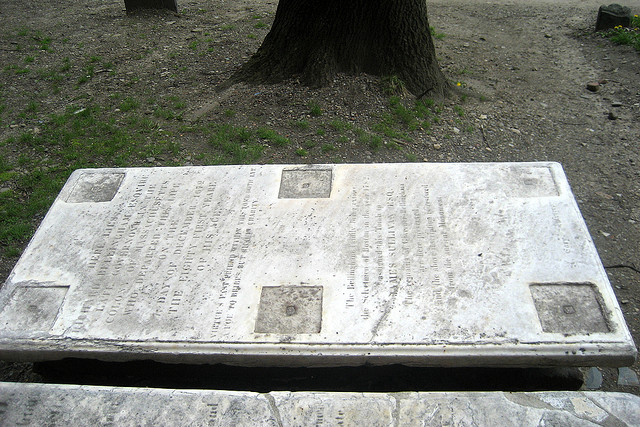
Sadly, it is impossible to get close to Bellingham's resting place, as the pathways do not go near it and are pretty strictly cordoned off from the graves. However, the shot below gives a fairly good view of the top of the tomb, which details the two inhabitants and tells us that Bellingham died in 1672 at the age of 81.

This photo, from Find a Grave, is far better than any of the ones I was able to take. 

Related Links:

This video is a fun intro to the Granary Burying Ground and its inhabitants.
Enough About Me: I once played Pearl Prynne in an adaptation of The Scarlet Letter. Freddie Tate portrayed Bellingham. 
You may notice another familiar name in this character list for The Scarlet Letter-- John Wilson, minister of the First Church of Boston, also makes an appearance.

Monday, January 15, 2018

Enough About Me: Improv in the Classroom and Giving Yourself Gifts

Here's a fun fact about me: I, like many other impressionable souls, did a stint of improv in college, and by a stint, I mean "became enmeshed in improv for five years, including spinoff groups, off-campus shows, and several 24-hour indoor-outdoor marathons during which I rapped outdoors in the chill of the early April air." I spent my 21st birthday presenting at an academic conference and then being elected President of the campus improv group. (For you Bojack Horseman fans: Yes, Todd's experience in the second season seemed a little familiar to me.) For those unfamiliar with the form, improvisational acting encompasses a variety of styles, from games of music, dialogue, and movement (think Whose Line is it Anyway?) to more cohesive long-form scenes which can be comedic or serious.


My toothy grin at receiving the "Greatest Hit" superlative in 2013. Photo from Spiked Punch Lines Improv. 

I learned a ton (and made a lot of friends!) from improv, and I'm not alone. The form has been touted for its applicability in the classroom both as an activity for students and as good practice for instructors. In both cases, key parts of its appeal are its encouragement to work together with others instead of competing with or ignoring them; to listen to another person and build off of what they have said instead of negating it (also known as "Yes, And"); and to accept and try out new ideas without fear of failure. These benefits are similar to those that Reacting to the Past games intend to encourage. Mark Carnes titled a chapter of his book on Reacting to the Past "Learning by Failing." Indeed, the in-game portions of RTTP have much in common with improv-- Mark Higbee describes being in a Reacting game by encouraging us to "Imagine being in a play with no director, no script, and no set conclusion" (48).

However, I admit I don't love the idea of actually doing straight-up improv in most classes, because it is so often used with little investment or warning. Whereas it often seems like it will be a fresh, exciting energizer to instructors, the experience of being a student in a class where you are confronted with Surprise Improv is often characterized by anxiety and/or annoyance (even among those who are outgoing or already do improv). Several articles linked above note that improv exercises trust, and the annoying thing about trust is that it has to be a) slowly built and b) consensually developed. I do think that courses can incorporate improvisation and performance effectively-- if the building of trust between participants occurs regularly and if students are warned about this aspect of the course early on, so that they can decide whether they wish to opt out. 

It's much easier to use a little improv to facilitate better teaching. I won't rehash some of the popular concepts that others have addressed about this connection, some of which can be found here-- these are good connections and for the most part true ones, but they're not the ones I draw from the most. Without a doubt my most evoked improv-related technique is "Give yourself gifts."  I don't know how common this concept is among improv communities; I learned it in a workshop given by Oklahoma City improv duo Twinprov.  One of the titular twins offered this simple suggestion about the very beginning of a scene. "Give yourself gifts," he said, "even before the scene starts." He raised his arm in the air as though he were holding something above his head and explained that unlike the scene that starts with two people slouching neutrally at one another, the scene in which you have a raised arm has an immediate point of interest. It raises a question: what is he holding in the air? You don't have to know the answer to that question immediately, but if you give yourself the gift of having something to hold, you have the opportunity to answer that question in your scene. 

I approach research and teaching with this concept in mind. When I see something of interest to me, even if I'm not sure why it's of interest or what I could use it for, I take a photo, write it down, save the link, etcetera. This is the reason I have photos of research documents that would be great to use in classes that I have no current plans to teach. By making note of primary sources, pieces of information, potential places to take a class or activities to do, I give the instructor I will be in the future, struggling to make some sort of cohesive course, an opportunity to develop a lesson around something that caught my interest even without context. I've also regretted my failing to give myself gifts, such as when I was writing my Greenwich Village post last week and discovered that I had failed to give myself the gift of writing down exactly which of my photos corresponded to which of the tour's listings (thanks, Google Street View!).

The nature of the gift I'm giving myself is also significant. In the improv workshop, the gift could vary but was always physical: holding something in the air, or performing a repetitive motion with your foot, or simply pointing. It is so easy in both improv and teaching to fall back on the strength of your words, simply cracking jokes or stating information without actually evoking a scene or a place. But this is boring, as is obvious when you are sitting in the back of the room but somehow forgettable when you yourself are delivering your fifth witticism of the afternoon. The gift concept reminds me to incorporate not only pictures and words but also movement and three-dimensionality into class activities. If I'm lecturing, I try to move around (sometimes to a fault-- I've been accused of pacing), gesture with my hands, and incorporate at least one thing that requires a little bit of spatial explanation (if colonial Boston is here where I'm standing, Rhode Island is way over there at the other end of the room). In a discussion session, making groups and then combining or redividing them does more than change the people involved;  it changes one's physical context and thus, just slightly, one's mental context. I took several classes from a professor who would make everyone move every once in a while, suggesting that seeing the room from a different vantage point just might help you see the material differently too.

What gifts do you give yourself? Does improv have a place in your classroom or approach to work? 

Monday, January 8, 2018

Reacting to Reacting: Taking the Greenwich Village Walking Tour

While in New York City last fall, I remembered that when I began teaching Mary Jane Treacy's Greenwich Village game, I had seen a self-guided walking tour somewhere among the extra materials. Rebecca Stanton created this great resource as an add-on to the game.  I saved the map onto my phone and set out to hit a few key stops in the world of the bohemians.

My itsy-bitsy phone map of the tour. Larger Word doc version here.
The descriptions of the places on the tour. I did a lot of reverse pinching/pinching out/stretching!

If you've played the game, you may remember that most game action took place as the characters hung out in Polly's restaurant (14). You may also remember well this image of Polly's, which I show at every opportunity! 


Men and women sitting at tables in Polly's Restaurant, with text that reads: When life is very strenuous and spirits are way down You'd better go to Polly's in little Greenwich town For there the clans are gathered-- its there you'll find em all The artists and the writers ranged along the wall. Miss Polly takes the money and Mike says he just can't Wait any faster on the folks in Polly's Res-tau-rant. J.T.B. Greenwich Village- New York
 Jessie Tarbox Beals' photo of Polly's.


When I visited, I couldn't quite see address numbers and get my bearings enough to figure out where the restaurant formerly was-- at the time, I thought it was this building:


Wilf Hall, formerly...not what I thought.
However, when I sat down to write this post, I discovered that Polly's was actually more likely to be down the street where this building now sits. From Polly's to pizzeria? Perhaps the smallest shift in function that I found from 1913 to today overall. A blog post on Polly Holladay from the Greenwich Village Society for Historic Preservation suggests that the majority of the block was demolished to make way for NYU law buildings, Wilf Hall being one. Wilf Hall, incidentally, turned out to be more relevant than I thought it would be when it turned out not to be Polly's. As this 2010 NYU Law Magazine piece about the then-new building assures us, the Provincetown Playhouse is the lone survivor of the block, still utilized as a "working theatre." As players of the game may remember, a number of figures from the game were pioneers in the Provincetown Players, including John Reed, Hutchins Hapgood, Neith Boyce, George Cram Cook, and Susan Glaspell. A History of the Provincetown Playhouse gives not only background details on the formation of the Players but also some fun insight into the Players' messy personal entanglements (sound familiar to any former bohemians?)

Besides Polly's, the bohemians had other neighborhood haunts, one being the Golden Swan Cafe (1). The dive bar was affectionately dubbed "The Hell Hole" and drew many of the Greenwich Village bohemians of the 1910s through its doors. Artist John Sloan, who plays a significant role in Greenwich Village, 1913, even did an etching of its raucous interior.


John Sloan's Hell Hole, 1917. Playwright Eugene O'Neill at upper right.

At present, the area is much more peaceful. As Stanton notes, since 2000 the site has been occupied by a small garden.


Sign for Golden Swan Garden, with outline of leaf.


Trees in the Golden Swan Garden.


Another angle on the Golden Swan Garden, showing some trees, a light post, and an empty pedestal planter.

I also visited the sites of two of John Reed's former apartments. The one he inhabited during the events of the Greenwich Village game once sat at 42 Washington Square (4), and inspired him to author a poem so delightful that I will reproduce it here even though Stanton has already included it in the tour:


In winter the water is frigid,                                                   
In summer the water is hot;                                                    
And we're forming a club for controlling the tub                   
For there's only one bath to the lot.
You shave in unlathering Croton,
If there's water at all, which is rare,--
But the life isn't bad for a talented lad
At Forty-Two Washington Square!

The dust it flies in at the window,
The smells they come in at the door,
Our trousers lie meek where we threw 'em last week
Bestrewing the maculate floor.
The gas isn't all that it should be,
It flickers,-- and yet I declare
There's pleasure or near it for young men of spirit
At Forty-Two Washington Square!

But nobody questions your morals,
And nobody asks for the rent,--
There's no one to pry if we're tight, you and I,
Or demand how our evenings are spent.
The furniture's ancient but plenty,
The linen is spotless and fair,
O life is a joy to a broth of a boy
At Forty-Two Washington Square!


As far as I could tell, the site of this joyous address now sits somewhere in the midst of this NYU building.

Forty-Two Washington Square!(?)

The second apartment Reed occupied in 1918, as he worked on his famous Ten Days that Shook the World (2).


147 W. 4th St. 


As Stanton notes, Polly's occupied this building as well, from 1915-17. How convenient for Reed! No need to leave the building to socialize or get the latest scuttlebutt from his fellow bohemians.

Visiting the former site of the Triangle Shirtwaist Factory is perhaps the oddest part of this excursion (7). The infamous fire, which killed over 140 workers on the upper floors of the Asch building (most of them young immigrant women), occurred in 1911. It launched investigations into workplace safety and inspired interest in labor movements among many locals. Yet it also followed memorable wins for women's labor movements, such as the 1909 Uprising of the 20,000, suggesting that existing efforts had not made as much change as they had hoped. The tragedy is momentous for a variety of historical and emotional reasons, and most students I've discussed it with have responded strongly to the personal narratives, the newspaper articles, and the images related to it found at Cornell's excellent online resource about the fire. The semi-recent centennial of the tragedy (has it been seven years since 2011 already?) inspired many commemorative actions and ceremonies. 

I had known that the building was in use by NYU and had been for some time, but I had expected that the site would be obvious, perhaps something of a tourist attraction with a statue or the like.  But the building (which suffered very little damage in the fire) appears in fact unremarkable. A bit of hunting reveals two plaques, one from the Department of the Interior in the 1990s and another one from 2003 by the New York Landmarks Preservation Foundation.


Plaque with text reading Triangle Shirtwaist Factory (Asch Building) has been designated a National Historic Landmark. The Triangle Shirtwaist Factory Fire, in which 146 workers died, occurred here on March 25, 1911. This building possesses national significance in commemorating the history of the United States of America. 1991. National Park Service United States Department of the Interior.
The National Park Service plaque.
Plaque with text reading Designated landmark New York City. The Brown Building, This ten-story neo-renaissance loft building, designed by New York architect John Wolley, was built in 1900-01 for Joseph J. Asch. THe Triangle Shirtwaist Factory occupied the building's top three floors. In 1909, Triangle employees initiated the first large-scale strike of women workers in the country, but workers' demands for increased fire safety were not met. On March 25, 1911, a fire swept through the factory, claiming the lives of 146 garment workers. Prompted by the outrage of reformers and labor unions, notably the ILGWU, New York State enacted legislation to safeguard the health and safety of workers. These laws subsequently served as models for national labor and safety reforms. The building facade was largely undamaged by the fire. In 1929 Frederick Brown donated the building to New York University, which named it in his honor, and has used it ever since as an academic building, New York Landmarks Preservation Foundation, 2003.
The New York Landmarks Preservation Foundation plaque.

These plaques are easy to miss, and people flow around them without cease. I seemed to be the only one there that day specifically to see the building which survived a fire that dozens of workers inside it did not. 

There is a current effort to place a memorial at the site. The Remember the Triangle Fire coalition has a plan for the design which will cleverly incorporate steel panels into the exterior of the building, stretching up to the eighth floor and around the base, with names and details of the fire etched upon them.  Until then, the view is a simple one. I found it a half-troubling reminder of the ways in which physical places can seem to move on from events that societies never quite do (as Stanton notes, sweated labor and unsafe working conditions are still alive and well in the modern US).


View of the Asch/Brown building from the sidewalk.

Related Links:

The Tenement Museum gives an idea of the living conditions of immigrant workers who worked in factories like Triangle, organized within labor unions like the IWW and ILGWU.
For teaching or just browsing around, Cornell's expansive resource on the Triangle Factory Fire is a must-visit, featuring primary sources, secondary descriptions, timelines, legacies, and more.